REGIONAL VS. NATIONAL ACCREDITATION – THERE’S A HUGE DIFFERENCE
The vast number of options available for students heading off to college or even thinking about heading to college can be rather daunting. While your educational experience will be what you make of it, wherever you go, there is one key thing you need to consider: is the institution accredited?
In the United States, accreditation means that the institution that you are planning on attending for your higher education is regularly assessed by an independent agency on the quality of the education it provides. There are two types of accreditation: the first is institutional, which refers to the entire institution. The second is program-based and relates to individual programs of study within the institution.
Institutional accreditation is a process that a college or university
voluntarily goes through. The institution requests that an accreditation
agency assess its programs, its faculty, and its students’ success, in
order to determine if these meet the standards for higher education. If
the standards are met, the institution is accredited and regularly
reassessed in order to make certain that the entire institution
continues to meet that standard.
Within an accredited institution individual programs may be accredited
separately from the overall institution. Depending on what career field
you want to enter, this may be more important than the institutional
accreditation. Psychology, education, medical specialties, engineering,
and social work, are fields that often times require that a student’s
program was accredited separately from the institution. Program-based
accreditation is conducted by the professional associations linked to
that field of study, such as the American Psychological Association for
Psychology. This type of accreditation makes certain that the program of
study meets the standards of the field for the education and
experiences that will result in the student having the background that
will lead to success in their field.
If you are not sure if the institution or the program you are interested
in is accredited and you have thoroughly checked its website and print
materials, the United States Department of Education keeps a database of
accredited institutions and programs accessible through its website: http://ope.ed.gov/accreditation/.
REGIONAL VS NATIONAL ACCREDITATION
Plain and simple, regional accreditation is not the same as national
accreditation. The main difference between the two are that credits
earned from institutions that are regionally accredited are more widely
accepted and thus more easily transferable.
Earning credits in college is like getting points in a game. Students
who earn enough points in a game level up. Leveling up in this game of
college credits is earning different degrees. Whereas points in a game
don’t usually transfer to another game, they do transfer to other
colleges. Online college students should be aware of the impact that
accreditation has on their degree journey. While national accreditation
might seem more authoritative that regional accreditation, this isn’t
always the case. Regional accreditation is older and more prestigious
While national accreditation might seem more authoritative that regional
accreditation, this isn’t always the case. Regional accreditation is
older and more prestigious that national, except in a few cases. Most
non-profit colleges have regional accreditation, not national
accreditation.
UNDERSTAND THE DIFFERENCES
REGIONAL ACCREDITATION
As implied in the name, regional accrediting organizations operate in
specific regions of the country. These organizations grant accreditation
to schools, colleges, and universities showing that their credits and
degrees meet minimum standards. This is a voluntary process that
self-regulates the higher education industry.
Regionally accredited colleges are mostly academically-oriented,
non-profit or state-owned institutions. Regionally accredited
institutions are reluctant to accept transfer credits from nationally
accredited institutions, mainly because the latter hasn’t met the
stringent standards of faculty qualifications and library resources.
Regional accrediting agencies each serve a certain geographic region of
the United States, and some of them serve international regions, as
well. They accredit postsecondary institutions as well as primary and
secondary schools. Each of these agencies is primarily concerned with
the accreditation of academically oriented, non-profit schools, rather
than technical or career-based schools. The University of Washington and
Pacific Lutheran University, for example, have each received
accreditation from the Northwest Commission on Colleges and
Universities. This type of accreditation granted by regional agencies is
known as institutional accreditation. It acknowledges that all
components of an institution are functioning and working towards
specific goals. There are six regional accrediting agencies that operate
in the United States:
Middle States Commission on Higher Education,
serving Delaware, the District of Columbia, Maryland, New Jersey, New
York, Pennsylvania, Puerto Rico, and the U.S. Virgin Islands.
New England Association of Schools and Colleges, serving Connecticut, Maine, Massachusetts, New Hampshire, Rhode Island, and Vermont.
North Central Association of Colleges and Schools,
serving Arizona, Arkansas, Colorado, Illinois, Indiana, Iowa, Kansas,
Michigan, Minnesota, Missouri, Nebraska, New Mexico, North Dakota, Ohio,
Oklahoma, South Dakota, West Virginia, Wisconsin, and Wyoming.
Northwest Commission on Colleges and Universities, serving Alaska, Idaho, Montana, Nevada, Oregon, Utah, and Washington.
Southern Association of Colleges and Schools,
serving Alabama, Florida, Georgia, Kentucky, Louisiana, Mississippi,
North Carolina, South Carolina, Tennessee, Texas, and Virginia.
Western Association of Schools and Colleges, serving California, Hawaii, Guam, and American Samoa.
Before transferring from a national to a regional institution, make sure
that the institution will accept the credits you’ve earned.
NATIONAL ACCREDITATION
Nationally accredited schools are generally for-profit and offer
vocational, career, or technical programs. National accreditation
generally offers accreditation to schools that focus on career or
religious education.
Nationally accredited schools will generally accept credits from other
nationally accredited schools and from regionally accredited schools.
National accrediting agencies have a slightly different function. As
their name suggests, national agencies accredit schools across the
entire country. They typically accredit vocational, technical, or
career-based, for-profit schools. While some agencies, such as the Accrediting Commission of Career Schools and Colleges, focus primarily on providing institutional accreditation, others, such as the American Academy for Liberal Education, offer both institutional and programmatic accreditation.
One of the key issues concerning regional and national accrediting
agencies is the transfer of credits earned. Many regionally accredited
institutes will not accept credits from nationally accredited institutes
and vice versa. Schools will, however, generally accept transfer
credits from schools with similar types of accreditation, because that
indicates that they have comparable curriculums and standards.
Programmatic, or specialized, accrediting agencies concentrate on
programs, departments, and schools within larger universities.
Institutions that receive accreditation from programmatic agencies
generally also have institutional accreditation. While some programmatic
agencies offer both programmatic and institutional accreditation, many
institutes choose to pursue institutional accreditation from a regional
agency. One of the prominent programmatic agencies is the National Architectural Accrediting Board , which bears sole responsibility for accrediting all architectural programs within the United States.
Just as institutions apply to these different agencies for
accreditation, the agencies apply to the U.S. Department of Education
for federal recognition. The process is somewhat similar: the Department
of Education establishes standards that recognized agencies should
meet, and teams evaluate the agencies to see if they satisfy those
criteria. An agency recognized by the government is analogous to an
educational institution accredited by an agency. Universities and
colleges can trust that such an agency is a valid, reputable source for
accreditation.
When you are browsing colleges, don’t just check if a school is
accredited. Check that the accrediting agency is also recognized by the
Department of Education. If the agency is not recognized, the school
should be avoided, just as if it had no accreditation at all. The
Department of Education maintains a list of recognized accrediting
agencies at its website.
WHY YOUR SCHOOL SHOULD BE ACCREDITED
In the United States, educational institutions are allowed to operate
with a great deal of freedom. Accreditation is awarded to schools that
meet basic standards of academic quality. These standards are determined
and developed by private organizations.
There are several large, regional accrediting associations, such as the Northwest Commision on Colleges and Universities,
which accredit institutions within a particular area of the United
States. These groups generally award accreditation to an entire
university. There are also, however, smaller, specialized accreditation
agencies. These agencies typically accredit smaller components of an
institution, such as a nursing program or a psychology department.
HOW SCHOOLS GET ACCREDITED
The process of obtaining accreditation has several steps. First, an
accreditation agency works with an educational institution to establish
reasonable criteria that must be met to receive accreditation. A school
then conducts a self-evaluation with these criteria in mind. If the
school determines that it meets the criteria, then it hosts an outside
evaluation team sent by the accrediting agency. Once the team is
satisfied that the proper standards have been met, the agency officially
grants accreditation to the institution. Once this accreditation has
been granted, the agency continues to monitor the institution, and
occasionally launches a full reevaluation, in order to ensure that it
continues to meet the standards.
WHY SOME SCHOOLS ARE NOT ACCREDITED
Some schools choose not to seek accreditation. This decision may be
based on several factors. The accreditation process is costly, and
accredited schools generally charge a higher tuition rate. A school
might offer a non-traditional learning format that, while it may provide
an otherwise complete and comprehensive education, does not adhere to
accreditation standards.
Some schools, on the other hand, do not seek accreditation because they
run poorly designed, ineffective programs. A school without
accreditation does not have either the credibility or the reputation of
an accredited school. Future employers, as well as graduate school
interviewers, might not consider a diploma valid if it is granted by a
school without accreditation. There is no way to tell if the diploma is
the result of an intensive course of study or a subpar, perhaps even
fraudulent, program.
Accreditation ensures not only the quality of program content, but also
the quality of teaching at an institution. Faculty are held to high
professional standards in terms of qualifications and teaching ability.
Instructors at schools without accreditation may not possess the degree
or the experience necessary to teach effectively.
ACCREDITATION AND TRANSFERRING CREDITS
For students wishing to transfer from one school to another, most
accredited institutions only accept credit from other accredited
institutions. Courses taken at a school without accreditation will need
to be repeated, costing more time and money.
Don’t be fooled by the low costs of schools without accreditation. The
long-term price of attending such an institution is much greater than
the tuition of any accredited school. Schools go through the
accreditation process in order to provide their students with a
worthwhile education that will be recognized by employers and other
schools. It’s worth taking advantage of this.
Paying attention to the kind of accreditation your school has is
especially important if there is any chance you may want to transfer to a
different school during your degree, or study elsewhere for a further
qualification. If your first school is not accredited, then your new
school is unlikely to accept the credits you have accumulated from your
studies there. Even if it is accredited, it will need to be accredited
by the same board as your new school if you want to be sure your credits
will transfer. The best way to ensure you will be free to transfer
credits is to attend only schools listed on the U.S. Department of Education’s website.
FINANCIAL AID AND ACCREDITATION
If an institution is neither regionally nor nationally accredited, no federal aid is available.
The majority of college students rely on some sort of financial aid to
help them pay for their education. Many students are eligible for loans
and grants from the federal government. Federal aid is only offered,
however, to students attending an accredited institution. The United
States Department of Education maintains a database of
federally-recognized accrediting bodies, as well as recognized
accredited institutions, at their website.
While schools without accreditation are often able to offer lower rates
of tuition, students usually end up paying more money out of pocket.

Enrolling in an accredited school can also make the difference between
receiving financial aid and paying everything out of your own pocket.
Schools accredited by the U.S. Department of Education provide financial
aid to the many students who qualify for grants or loans.
Non-accredited schools are not eligible to offer financial aid to their
students.
PLAN AHEAD FOR TRANSFERRING
According to recent data
from The National Student Clearinghouse Research Center, more than a
third of college students transfer at least once within six years.
Nearly 54 percent of students transferred from four-year institutions to
two-year community colleges.
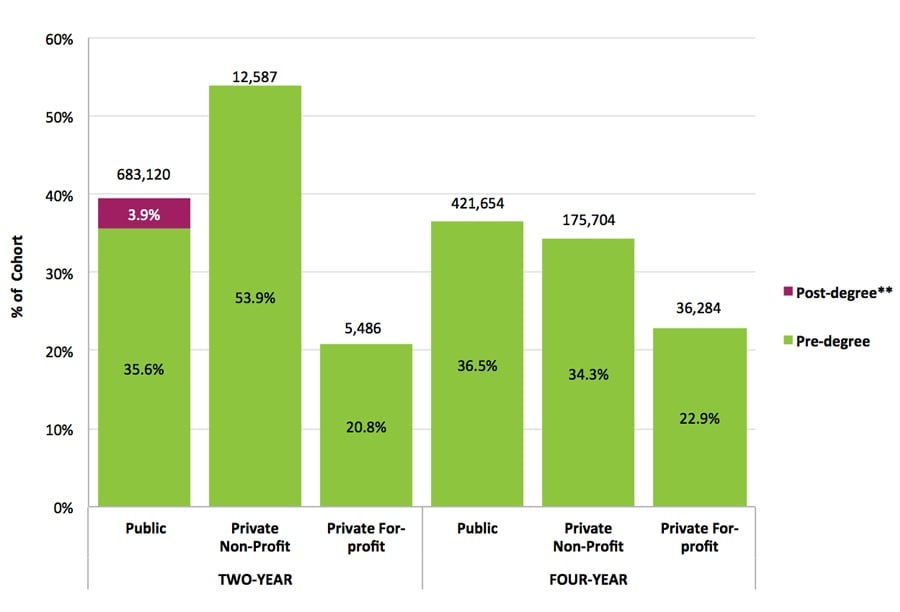
Changes in one’s college plans are often unforeseen. Roughly 67 percent
of college students graduate from the school they first started. Thus,
the importance of choosing a regionally accredited institution right off
the bat. Regionally accredited institutions typically accept credits
from schools that hold similar credentials. Nationally accredited
schools typically accept credits from other national institutions.
Enrolling in an accredited school can also make the difference between
receiving financial aid and paying everything out of your own pocket.
Schools accredited by the U.S. Department of Education provide financial
aid to the many students who qualify for grants or loans.
Non-accredited schools are not eligible to offer financial aid to their
students.
By choosing a regionally accredited college, students open up their pool
of potential universities that will accept their hard-earned credits,
this is especially so for online college students.
HOW TO KNOW A COLLEGE’S ACCREDITATION
Qualifying for regional accreditation is a rigorous process. The U.S. Department of Education offers a free tool
that allows you to search for accreditation. The U.S. Dept of Education
recognizes seven regional accrediting bodies that meet the standards of
the Council of Higher Education.
Middle States Commission on Higher Education (MSCHE)
Schools in New York, Delaware, Maryland, Pennsylvania, the District of
Columbia, Puerto Rico and the Virgin Islands are accredited by MSCHE.
New England Association of Schools and Colleges
Commission on Institution of Higher Education (NEASC-CHE)
Schools in Rhode Island, Maine, New Hampshire, Vermont, Connecticut and Massachusetts are accredited by NEASC-CHE.
North Central Association of Colleges and Schools
The Higher Learning Commission (NCA-HLC)
Schools in Wyoming, Arizona, North Dakota, West Virginia, Missouri,
Ohio, Indiana, Arkansas, Colorado, Iowa, New Mexico, South Dakota,
Wisconsin, Nebraska, Illinois, Minnesota, Oklahoma, Michigan and Kansas
are accredited by NCA-HLC.
Southern Association of Colleges and Schools (SACS)
Commission on Colleges
Schools in Florida, Texas, Louisiana, North Carolina, Tennessee,
Alabama, Kentucky, Georgia, Virginia, Mississippi and South Carolina are
accredited by SACS.
Western Association of Schools and Colleges
Accrediting Commission for Community and Junior Colleges (ACCJC-WASC)
Schools in California and Hawaii in addition to those in American Samoa,
the Territories of Guam, the Republic of Palau, the Commonwealth of the
Northern Mariana Islands, the Republic of the Marshall Islands, and the
Federated States of Micronesia are accredited by ACCJC-WASC.
REGIONAL AND NATIONAL INSTITUTIONAL ACCREDITING AGENCIES
“The following regional and national accrediting agencies are recognized
by the Secretary as reliable authorities concerning the quality of
education or training offered by the institutions of higher education or
higher education programs they accredit.” – Ed.Gov
Accrediting Commission of Career Schools and Colleges
1967/2011/S2016
Scope of recognition: the accreditation of postsecondary,
non-degree-granting institutions and degree-granting institutions in the
United States, including those granting associate , baccalaureate and
master’s degrees, that are predominantly organized to educate students
for occupational, trade and technical careers, and including
institutions that offer programs via distance education.
Michale McComis, Executive Director
2101 Wilson Boulevard, Suite 302
Arlington, Virginia 22201
Tel. (703) 247-4212, Fax (703) 247-4533
E-mail address: mccomis@accsc.org
Web address: www.accsc.org
Accrediting Council for Continuing Education and Training
1978/2013/S2018
Scope of recognition: the accreditation throughout the United States of
institutions of higher education that offer continuing education and
vocational programs that confer certificates or occupational associate
degrees, including those programs offered via distance education.
Title IV Note: Only those institutions classified by this agency as
“vocational ” may use accreditation by the agency to establish
eligibility to participate in Title IV programs.
William V. Larkin, Executive Director
1722 N Street, NW
Washington, DC 20036
Tel. (202) 955-1113, Fax (202) 955-1118
E-mail address: wvlarkin@accet.org
Web address: www.accet.org
Council on Occupational Education
1969/2013/S2016
Scope of recognition: the accreditation and preaccreditation (“Candidacy
Status”) throughout the United States of postsecondary occupational
education institutions offering non-degree and applied associate degree
programs in specific career and technical education fields, including
institutions that offer programs via distance education.
Gary Puckett, Executive Director
7840 Roswell Road, Building 300, Suite 325
Atlanta, Georgia 30350
Tel. (770) 396-3898, (800) 917-2081, Fax (770) 396-3790
E-mail address: puckettg@council.org
Web address: www.council.org
Distance Education Accrediting Commission
1959/2012/S2017
Scope of recognition: the accreditation of postsecondary institutions in
the United States that offer degree and/or non-degree programs
primarily by the distance or correspondence education method up to and
including the professional doctoral degree, including those institutions
that are specifically certified by the agency as accredited for Title
IV purposes.
Title IV Note:Only accredited institutions that are certified by the
agency as accredited for Title IV purposes may use accreditation by this
agency to establish eligibility of its degree and/or non-degree
programs to participate in Title IV programs.
Leah K. Matthews, Executive Director
1101 17th Street NW, Suite 808
Washington, DC 20036
Tel. (202) 234-5100, Fax (202) 332-1386
E-mail address: info@deac.org
Web address:www.deac.org
Middle States Commission on Higher Education
1952/2012/F2017
Scope of recognition: the accreditation and preaccreditation (“Candidacy
status”) of institutions of higher education in Delaware, the District
of Columbia, Maryland, New Jersey, New York, Pennsylvania, Puerto Rico,
and the U.S. Virgin Islands, including distance and correspondence
education programs offered at those institutions.
Elizabeth H. Sibolski, President
3624 Market Street
Philadelphia, Pennsylvania 19104
Tel. (267) 284-5000, Fax (215) 662-5950
E-mail address: info@msche.org
Web address: www.msche.org
Middle States Commission on Secondary Schools
2004/2014/S2017
Scope of recognition: the accreditation of institutions with
postsecondary, non-degree granting career and technology programs in
Delaware, Maryland, New Jersey, New York, Pennsylvania, the Commonwealth
of Puerto Rico, the District of Columbia, and the U.S. Virgin Islands
to include the accreditation of postsecondary, non-degree granting
institutions that offer all or part of their educational programs via
distance education modalities..
Title IV Note:Only those vocational/technical schools accredited by this
agency that offer non-degree, postsecondary education may use that
accreditation to establish eligibility to participate in Title IV
programs.Henry Cram, President
3624 Market Street, 2 West
Philadelphia, Pennsylvania 19104-2680
Tel. (267) 284-5000, Fax (215) 662-0957
E-mail address: jpruitt@msa-cess.org
Web address: www.msa-cess.org
New England Association of Schools and Colleges, Commission on Institutions of Higher Education
1952/2015/F2017
Scope of recognition: the accreditation and pre-accreditation
(“Candidacy status”) of institutions of higher education in Connecticut,
Maine, Massachusetts, New Hampshire, Rhode Island, and Vermont that
award bachelor’s, master’s, and/or doctoral degrees and associate
degree-granting institutions in those states that include degrees in
liberal arts or general studies among their offerings, including the
accreditation of programs offered via distance education within these
institutions..
Barbara E. Brittingham, President
3 Burlington Woods Drive, Suite 100
Burlington, Massachusetts 01803-4514
Tel. (781) 425-7700, Fax (781) 425-1001
E-mail address:bbrittingham@neasc.org
Web address: https://cihe.neasc.org
New York State Board of Regents, and the Commissioner of Education
1952/2012/F2017
Scope of recognition: the accreditation of those degree-granting
institutions of higher education in New York, including distance
education offered by those institutions, that designate the agency as
their sole or primary nationally recognized accrediting agency for
purposes of establishing eligibility to participate in HEA programs.
MaryEllen Elia, Commissioner of Education
State Education Department
The University of the State of New York
89 Washington Avenue
Albany, New York 12234
Tel. (518) 474-5844 Fax (518) 473-4909
E-Mail address: commissioner@nysed.gov
Web address: www.nysed.gov
North Central Association of Colleges and Schools, The Higher Learning Commission
1952/2015/F2017
Scope of recognition: the accreditation and preaccreditation (“Candidate
for Accreditation”) of degree-granting institutions of higher education
in Arizona, Arkansas, Colorado, Illinois, Indiana, Iowa, Kansas,
Michigan, Minnesota, Missouri, Nebraska, New Mexico, North Dakota, Ohio,
Oklahoma, South Dakota, West Virginia, Wisconsin, and Wyoming,
including the tribal institutions and the accreditation of programs
offered via distance education and correspondence education within these
institutions. This recognition extends to the Institutional Actions
Council jointly with the Board of Trustees of the Commission for
decisions on cases for continued accreditation or reaffirmation, and
continued candidacy, and to the Appeals Body jointly with the Board of
Trustees of the Commission for decisions related to initial candidacy or
accreditation or reaffirmation of accreditation.
Barbara Gellman-Danley, President
230 South LaSalle Street, Suite 7-500
Chicago, Illinois 60604-1413
Tel. (312) 263-0456, (800) 621-7440, Fax (312) 263-7462
E-mail address: bgdanley@hlcommission.org
Web address: www.hlcommission.org
Northwest Commission on Colleges and Universities
1952/2015/S2016-C
Scope of recognition: The accreditation and preaccreditation (“Candidacy
status”) of postsecondary degree-granting educational institutions in
Alaska, Idaho, Montana, Nevada, Oregon, Utah, and Washington, and the
accreditation of programs offered via distance education within these
institutions.
Sandra E. Elman, President
8060 165th Avenue, NE, Suite 100
Redmond, Washington 98052
Tel. (425) 558-4224, Fax (425) 376-0596
E-mail address: selman@nwccu.org
Web address: www.nwccu.org
Southern Association of Colleges and Schools, Commission on Colleges
1952/2014/S2017
Scope of recognition: the accreditation and preaccreditation (“Candidate
for Accreditation”) of degree-granting institutions of higher education
in Alabama, Florida, Georgia, Kentucky, Louisiana, Mississippi, North
Carolina, South Carolina, Tennessee, Texas, and Virginia, including the
accreditation of programs offered via distance and correspondence
education within these institutions. This recognition extends to the
SACSCOC Board of Trustees and the Appeals Committee of the College
Delegate Assembly on cases of initial candidacy or initial accreditation
and for continued accreditation or candidacy.
Belle S. Wheelan, President
1866 Southern Lane
Decatur, Georgia 30033-4097
Tel. (404) 679-4512, Fax (404) 994-6592
E-mail address: bwheelan@sacscoc.org
Web address: www.sacscoc.org
Transnational Association of Christian Colleges and Schools, Accreditation Commission
1991/2013/S2016
Scope of recognition: the accreditation and preaccreditation
(“Candidate” status) of Christian postsecondary institutions in the
United States that offer certificates, diplomas, and associate,
baccalaureate, and graduate degrees, including institutions that offer
distance education.
Timothy W. Eaton, President
15935 Forest Road
Forest, Virginia 24551
Tel. (434) 525-9539, Fax (434) 525-9538
E-mail address: president@tracs.org
Web address: www.tracs.org
Western Association of Schools and Colleges, Accrediting Commission for Community and Junior Colleges
1952/2015/S2017-C
Scope of recognition: The accreditation and preaccreditation (“Candidate
for Accreditation”) of community and other colleges with a primarily
pre-baccalaureate mission located in California, Hawaii, the United
States territories of Guam and American Samoa, the Republic of Palau,
the Federated States of Micronesia, the Commonwealth of the Northern
Mariana Islands, and the Republic of the Marshall Islands, which offer
certificates, associate degrees, and the first baccalaureate degree by
means of a substantive change review offered by institutions that are
already accredited by the agency, and such programs offered via distance
education and correspondence education at these colleges. This
recognition also extends to the Committee on Substantive Change of the
Commission, for decisions on substantive changes, and the Appeals Panel.
Barbara A. Beno, President
10 Commercial Boulevard, Suite 204
Novato, California 94949
Tel. (415) 506-0234, Fax (415) 506-0238
E-mail address: accjc@accjc.org
Web address: www.accjc.org
Western Association of Schools and Colleges, Senior Colleges and University Commission
1952/2012/F2017
Scope of recognition: the accreditation and preaccreditation (“Candidate
for Accreditation”) of senior colleges and universities in California,
Hawaii, the United States territories of Guam and American Samoa, the
Republic of Palau, the Federated States of Micronesia, the Commonwealth
of the Northern Mariana Islands and the Republic of the Marshall
Islands, including distance education programs offered at those
institutions.
Mary Ellen Petrisko
President
985 Atlantic Avenue, Suite 100
Alameda, California 94501
Tel. (510) 748-9001, Fax (510) 748-9797
E-mail address: wasc@wascsenior.org
Web address: www.wascsenior.org
source : LINK
ADSENSE DISINI
0 Response to "nationally accredited online colleges "
Posting Komentar